The living room at Soundcliff, transformed into temporary office...
Spring has definitely sprung in the Pacific Northwest. We’re seeing premature magnolia blossoms, tulips, daffodils, rhododendrons, cherry blossoms and more!
It definitely lifts the moods of everyone I can see.Gordon and I have been introducing color into our house, after 12 years of living in a house painted entirely Navajo White. After painting our living room wall a warm bricky red, we decided my office needs a red wall, too.
Bill Palmer masks the room in preparation for painting the office wall
Bill Palmer, our wonderful neighbor who is an exacting painter, agreed to spend an extra day painting my office wall if I would clear it out. It was a dare.
Bill Palmer, the amazing neighbor, painter, storyteller, father and raconteur
Those who know me know that my office looks like a cycloned paper junkyard. Not any more.
What surprised me most was that I discovered (duh!) that I write hundreds of notes, to-dos, and names of people on small scraps of paper, then bury them in my piles.Having unearthed most of my piles, I now have a to-do list that may number 200 things, but it’s organizable!
Now both walls are red -- the house harmonizes! (Thanks again, Gordon/Bell!)
This is revolutionary for me.Stay tuned to see how long it lasts…
The amazing Golden Gate Bridge, which we crossed a number of times on our way to and from digit productions, where we rented gear
San Francisco and its gorgeous surrounds was where James Broughton spent most of his life.
It’s always fun to go there and meet people who were influenced directly and indirectly by him.You can still feel his spritely spirit dancing around the city.
Eric Slade, Big Joy documentary director, and I swung through for two interviews after our time in Los Angeles and Santa Barbara.Art Adams worked skillfully behind the camera.
Keith Hennessy is an amazing performance artist, dancer, and queer theorist who considers Broughton one of his ancestors and inspirations.“There’s a queer scene and an artistic scene that I’m in, where Broughton has always been present,” Hennessy told us before a dress rehearsal for his current performance, CROTCH.
“The more I see him as someone who helped set up the conditions – the material, the psychological, the imagistic, the psychic conditions under which I operate, as both as an artist and as a gay person—the more I start to perform out of that place, to extend that lineage.”
Keith Hennessy at Dance Mission before he took off his clothes for (part of) the performance, "Crotch"
“He has a kind of child’s eye view on the body and sex and God and the earth and all their interrelations.He brings a combination of innocence and curiosity to each of those pursuits.”
Here I am with Anna Halprin, at the beautiful Marin County home she and her husband Lawrence built in the 1950's
Friday, we got to visit Anna Halprin, the dancer and choreographer who was part of James’s life from the 1940’s on.In a way, she was his muse – the dancer he always wanted to be.And she danced to his poetry, as you can see in a brief scene in the Big Joy trailer.
Anna was married to Lawrence Halprin, one of the great landscape architects of the 20th Century, who passed on last October.Together, they inhabited a creative space in Marin County, where we interviewed Anna.
She and James were part of the “San Francisco Renaissance” after World War II – an important story we’ll be able to tell in the Big Joy film.She described the creative environment:“We were very free and open-ended, not very self-aware.There was a lot of fun, excitement, cross-pollination between us.
“In New York, the dance scene was more traditional.I was working alone, but in connection with the painters, the poets, architects, the actors’ workshop – looking for stimulation, cross-fertilization.The word multi-disciplinary came up as a description of the work we were doing.
“James and I had a special relationship because we both enjoy wit.I never could take anything too seriously around him. … We both dealt with serious subjects in a witty way.”
We shoot Anna dancing James Broughton's poetry at San Francisco's Palace of Fine Arts in Broughton's film "Four in the Afternoon" (1951)
Being with Anna in her beautiful home was inspiring to me, and gave me a better sense of the community she and Lawrence shared with James Broughton, Alan Watts, Imogene Cunningham, Richard Brautigan, and others.
Cinematographer Ian Hinkle and Director Eric Slade line up the perfect shot of the Pacific Ocean, a spiritual soulguide for James Broughton
Eric Slade and Ian Hinkle and I just finished three days of shooting in Los Angeles! We barely escaped the rains, and had lovely weather and an amazing host.
It’s becoming a tradition in the Big Joy Project to start with a challenging interview. The first time we worked together last April on the Big Joy film, we interviewed James Broughton’s ex-wife Suzanna Hart, a wonderful artist who lives in a senior facility in Mill Valley. She seems to be in a state of permanent memory-lapse, so her answer to the first questions was “I don’t remember.”
After we showed her the “program” she created for her wedding to James in 1962, her memory started to return. By the end of the interview, she was so cogent we looked at each other and said, “This interview was worth the trip to San Francisco!” (Ian lives in Victoria, Eric in Portland, and I near Seattle.)
You can see her in the trailer for the film, which we finally got online after YouTube censored it for nudity. (Go figure – if it were grossly violent they wouldn’t censor it. James’s films were also banned in St. Louis and censured by PBS in the 1980’s.)
Poet Robert Peters' portrait was done by Don Bachardy. When he saw the microphone there, Peters asked "Is he going to talk?"
On this trip, we interviewed the preeminent poet and poetry critic Robert Peters, who did some of the best analysis of James’s poetry in the 1970’s and for years taught at the University of California at Irvine. He’s also suffering from some kind of senile dementia. He’s very jolly, has a great sense of humor, but remembers little. However, when he read James Broughton’s poetry, he did it with rare verve:
Are you willing to go to your own infinity Willing to relish a really fine undoing? What's wrong with going all the way for a bangup crucifixion?
As things are now everyone is mad asleep or on the wrong bus
-- James Broughton
It was fun to see Peters and his life partner poet Paul Trachtenberg watching a scene from James Broughton and Joel Singer’s film Devotions where they are lifting weights and doing intimate athletics together in their back yard.
Don Kilhefner in the living room of Michael G's house in LA
We also had a great interview with Don Kilhefner, a therapist and pioneer of the gay liberation movement who really understands James Broughton’s Jungian analysis and his role as an early leader of the Radical Faeries.
The next day we interviewed Mark Thompson, an author and photographer who knew James better than most and who was responsible for convincing me I needed to make a film about James rather than writing a book. “If you write a book,” he told me in 2008, “it’ll take eight years to do it right, and nobody will read it because who’s heard of James Broughton? If you make a film, and it ‘s good, you’ll have an audience if you still want to do a book.”
Obviously, I took his advice. And look at the fine mess I’ve gotten myself into, as Laurel and Hardy would say.
Not quite Laurel and Hardy: Mark Thompson and Stephen Silha
We also got to interview Mark’s husband Malcolm Boyd, the famous Episcopal priest who wrote the best-selling Are You Running with Me, Jesus? and Take Off the Masks. He coined a new word explaining James in our interview: “quadra-sexual.”
Our host in LA was Michael G, and old friend and surely the host with the most. His home, his cooking, and his repartee ware truly inspired. The only downside was that his dogs ate all my energy bars and tried to eat one of Gordon’s bells. (Actually, he only ate the leather cord and the bronze ‘This is It” bell is still for sale at a bargain price on the Big Joy website!)
We also had a wonderful dinner at Vermont, a restaurant which Michael and his partner Manuel created and re-created.
We then drove to Santa Barbara where we interviewed one of my favorite practitioners of Big Joy, the author and poet Michael Hathaway. He’s truly “The Gardener of Eden,” and we got to shoot him in his garden and on the beach. Michael Hathaway
Michael, Ian and Eric in Michael's garden of eden
More from California coming soon.
Stephen and Ian on the beach at Santa Barbara: messages from the sea coming in
We celebrated Thanksgiving, my favorite holiday, again this year at Soundcliff (the house where Gordon and I live), as I have every year since I moved here in 1989. (Except the year that the house was under reconstruction, when we moved our ceremonies to James Broughton and Joel Singer’s house in Port Townsend, WA.)
As usual, we began at 1 p.m. and ended the Thanksgiving feast around 10 p.m. Before, during, and after the courses (everyone brought a course), people hiked, read poetry, asked questions.
Thanksgivers: Michael Hathaway, Chris Young, Shawn Boley, Whitney Kimball, Malcolm Dorn, Gordon/Belle, Orlando, Tom Pruiksma, David Mielke, Sequoia
Two poems were written for this occasion which I’d like to share.The first, our invocation, from Tom Pruiksma:
The Big Joy
for Stephen
I want
on this day
as they say
of thanksgiving
to give thanks
for love
and for joy
too little of either
in the world
that we’ve made
the world
that covers up
the world
but the joy
that we name
is not the joy
that we know
always
just beyond words
always beyond
what the eyes
can see
what a tongue
with practice
can say
like our friend
the little frog
outside the door
or perhaps
a little inside
the way we go out
or even
between walls
between worlds
his song
keeps our hearts singing
in spite of the new darkness
and descent
of the year
the fear
we won’t make it
this time
all fears
are really fears
of loving
and being loved
are fears
of getting the gift whole
no light
without darkness
and the terrors of seeing
no sight
without sunshine
in the eyes
listen
do you hear
what I say
no sorrow
without its own joy
say one
and the other is
even
in the saying
even
sailing out
from hearth
and from home
even
in the silence
before dawn
health demands more
than a little sorrow
or a little joy
a big sorrow
big enough
for big joy
big joy
a big joy
big enough for sorrow
the freedom
of the frog’s
lone song
and so
today
between past and
tomorrow
I give thanks
for the sorrow
that completes the big joy
the great sorrow
and great joy
beyond words
-- Thomas H. Pruiksma
11/26/2009
Orlando chats with Gordon and Michael as dishes are prepared
We had already had our first course, prepared by Whitney and Shawn, Michael and Stephen:
Bruscetta with avocado, sundried tomato, black bean garlic sauce
Tango is in the air in Buenos Aires's Boca neighborhood--and everywhere. Boca is famous for beautiful colored buildings and futbol (soccer). We were surprised to find how full of slums it is, too.
My first visit to the Southern hemisphere was in 1997, just when I started to find winters in the Northwest depressingly dreary instead of excitingly gray. It was a November trip to New Zealand and Australia, where I delighted in spring-soaked attitudes, Maori and aboriginal culture, different constellations, great food and wine, and lengthening days.
On my first visit to Buenos Aires, I was fascinated by the Sunday market in the San Telmo neighborhood. This time, I stayed just around the corner.
This fall, I’m fortunate to be basking in spring weather and long days in Argentina.It’s my second time in this country of vast contrasts, proud traditions, and beautiful people.(The first time, five years ago, I was doing some intensive consulting for a project of the Bill and Melinda Gates Foundation and had too little time to explore Argentina.)
I’m exploring with one of my favorite travel companions, Edward Guthmann, who until recently wrote about culture for the San Francisco Chronicle.We’ve visited Cuba, Turkey, and Italy together in recent years.
Edward and Alfredo Ferreyra. Alfredo invited us to his apartment -- the second "home" we'd been in on this trip. Travel's always better when you know locals.
My first time in Argentina, I was fortunate to meet Alfredo Ferreyra, a sophisticated travel agent who showed me around Buenos Aires.He arranged for us to explore Patagonia on this trip – “fin del mundo” : the end of the world… and the world’s only glacier that’s not receding, El Perito Moreno.Two very different parts of Patagonia. And then there's Buenos Aires, which is an astounding city. As Edward says, "Why did it take me so long to discover Argentina?"
Alfredo lives in the Recoleta neighborhood of Buenos Aires, which also has one of the most gorgeous cemeteries I've ever seen. This boy likes his foliage.
The most famous grave in the cemetery belongs to none other than Evita -- Eva Peron, the actress who was married to President Juan Peron and about whom a musical and movie were made.
After a week in Bue, as they call it, we headed south for two destinations in Patagonia.
Here are a few more photographic highlights of the trip so far (I'll add more later) …
Normally, I dislike touristy dinner-entertainment packages, but the tango show we saw at an ancient tango-house in our own neighborhood was spectacular. We tried it at the recommendation of Michelle Moore and Annie Nixon, two friends of my neice Sarah with whom we had had a scrumptious Moroccan dinner. The performance inspired us to take a tango lesson the next day!
One of the great joys of travel for me is meeting unexpected new friends. Both Edward and I enjoyed hanging out with Mark Lee from Sydney, Australia -- and when we visited the Uruguayan town of Colonia del Sacramento, we were delighted when he showed up at a restaurant where we were lunching.
After a great week in Buenos Aires, we flew to "the end of the world" -- the planet's southernmost city, Ushuaia -- a former penal colony which sits on the Beagle Channel, which I think is pictured above, if it's not the Strait of Magellan.
While in Ushuaia, we took a boat ride that went by some blue-eyed cormorants (above), sea lions, and penguins
Our boat stopped at a fishing vessel, where smiling fishermen handed us a centolla, or King Crab, which is a premier delicacy of the region.
At an astoundlingly beautiful Estancia,or ranch near El Calafate, we feasted on lamb, watched gauchos herd cattle and sheep, and saw a sheep shorn by hand.
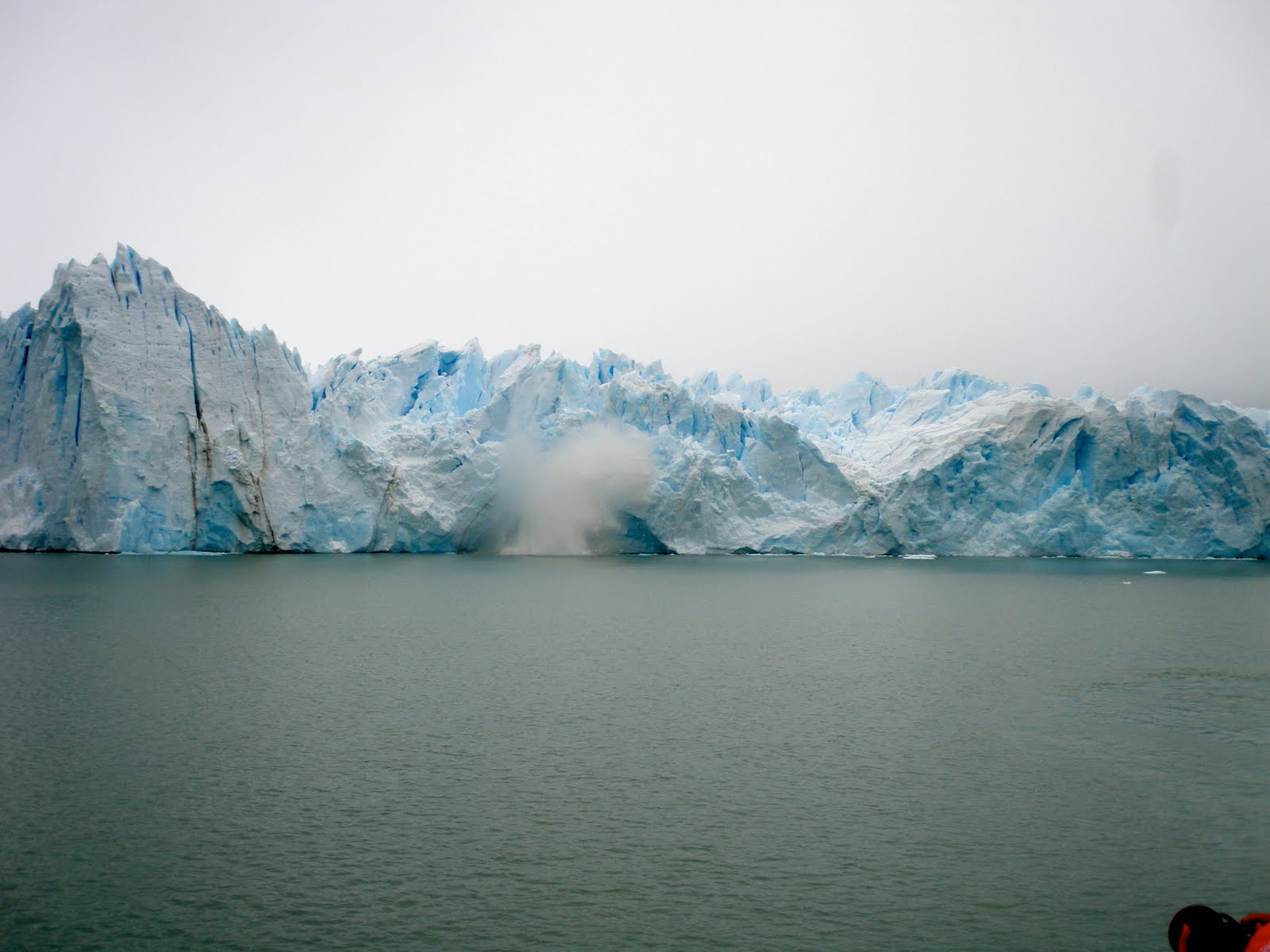
A visit to El Calafate and the amazing Glacier National Park allowed us to have an up-close-and-personal look at one of South America's biggest glaciers, and the only one on the planet that's holding its own in size and not receding. Here, you can see a chunk falling off -- it's calving, as they say.
But I think our family milestones will be the key.
Gordon, Helen and I love to spend time together in Florida, in Minnesota, in Europe, and at Soundcliff (our house)
In 2009, Helen Silha, my amazing mother, celebrated a big decade birthday in May.She came to Seattle to visit Gordon and me, proclaiming that she wanted a quiet dinner with us to celebrate the occasion (rather than a big party my sister might throw for her in the Twin Cities).
Surprise! Alice Reimann (my sister) hugs Helen in a surprise appearance in our kitchen
Johnny Reimann, John Reimann, Helen Silha, David Reimann and Mark Silha about to munch on Salmon dinner at Soundcliff
We held the quiet salmon dinner – but surprised her with the whole family showing up.It happened exactly a year after a fatal accident nearly killed my nephew, David Silha Reimann, so we celebrated both Helen’s birthday and David’s astounding recovery.
David Silha Reimann and I prepare an Ebelskiver breakfast for the family
As if that weren’t enough to celebrate, we also marked a 50th birthday for my brother Mark in July!
When Mark was born, my parents were told he probably wouldn't live past 18. We celebrate 50 and many more!
Mark loved the attention -- the cards, presents, and most of all the presence of good friends, old and new.
Mark and Gordon get down on the dance floor at Mark's great Soundcliff birthday party
Mark's cake -- a Gordonian bundt cake -- was marvelous!
Mark and I went to Camp Parkview for a week in August, and had a great time.
Mark and I hung out with 60 campers and 25 counselors at the beautiful Camp Burton land on Vashon
Dawn and Mark danced to the amazing inspired music of an Elvis impersonator
Master storyteller Merna Hecht transformed campers like Mark into gorgeous creatures
And now, this week, we celebrate the 25th anniversary of the Silha Center for the Study of Media Ethics and Law, which my parents created in 1984 at the University of Minnesota, the day after Otto, my dad, retired from a career at the Minneapolis Star and Tribune Company.He was a Horatio Alger – he worked his way up from copy desk editor to CEO of the parent Cowles Media Company.
We commissioned this painting of Otto A. Silha and presented it to him at his 80th birthday celebration
And after he retired, Otto not only announced the creation of the Silha Center, he also created his consulting firm and worked on his futuristic City Innovation project until the day he died – September 11, 1999.
As a family, we are grateful to him, and to each other, on this and every day.